

By Elias Makori
In 2000, Ethiopian distance running legend Haile Gebrselassie predicted that a one-hour-58-minute marathon would be possible “soon.”
In 2019, Kenya’s marathon G.O.A.T. Eliud Kipchoge proved that, indeed, a sub-two in race conditions is possible by breaking the two-hour barrier in a well-choreographed but non-record compliant “INEOS 1:59 Challenge” in Vienna, running 1:59:40.
This after having run 2:00:25 in his first sub-two attempt at the Autodromo Nazionale Monza in Monza, Italy, on May 6, 2017, in another non-record compliant run aided by lasers and a retinue of pacemakers peeling off at determined intervals.
And running at the 2023 Chicago Marathon, Kelvin Kiptum proved it was just a matter of time before someone broke the iconic two-hour mark in a record-compliant, competitive marathon when he lowered Kipchoge’s world marathon record by 34 seconds to a jaw-dropping 2:00:35.
Sadly, Kiptum died in a car crash in February 2024 at a time he was preparing to target a 1:58 at that year’s Rotterdam Marathon and just after his world record was ratified.
He didn’t live to see, or run, a sub two-hour marathon…
Greatest marathon ever
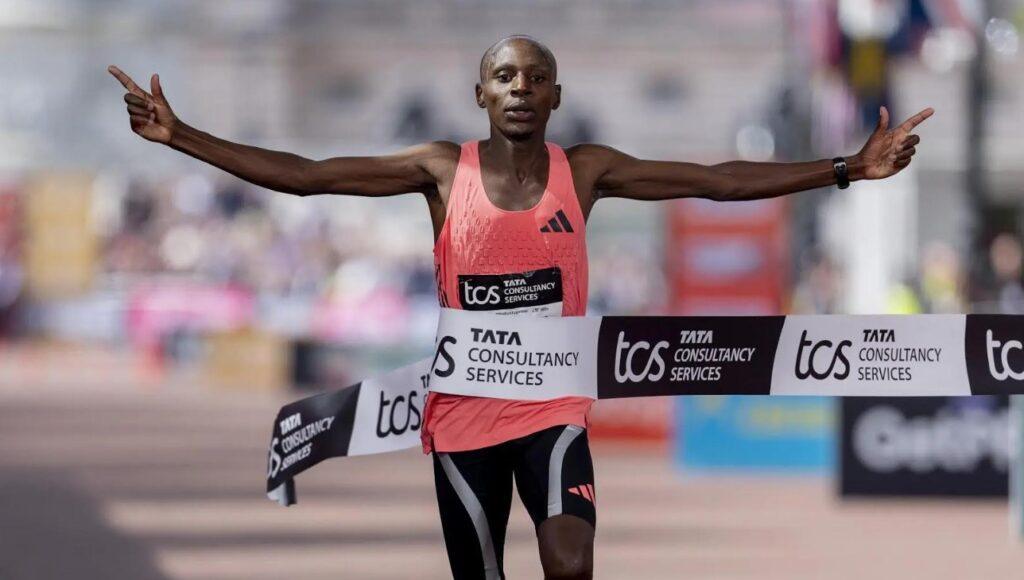
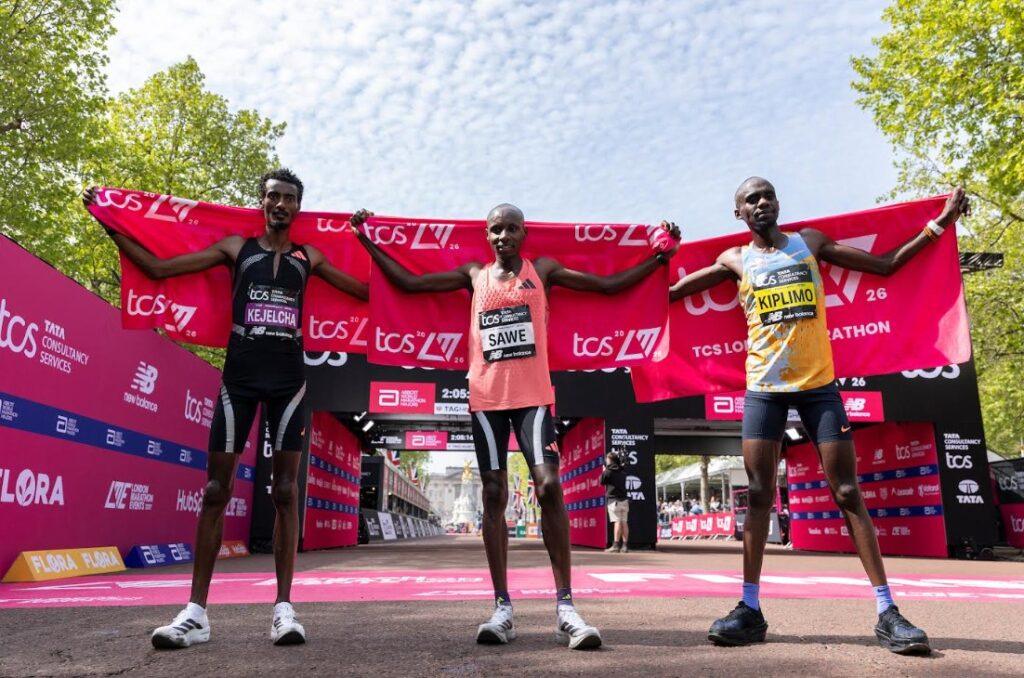
But on Sunday, just 20 days after the four-man Artemis II crew set a new record of a human crew by traveling the furthest distance from Earth (406,773 km), beating Apollo 13’s 1970 record, Sebastian Sawe, 31, raised human limits in the marathon to unprecedented levels, going just 30 seconds outside Haile’s prophesy 26 years ago with an incredible 1:59:30 on the streets of London in a race that saw Ethiopia’s track specialist Yomif Kejelcha also dip under 2:00 with an unbelievable 1:59:41 debut.
It was surreal.
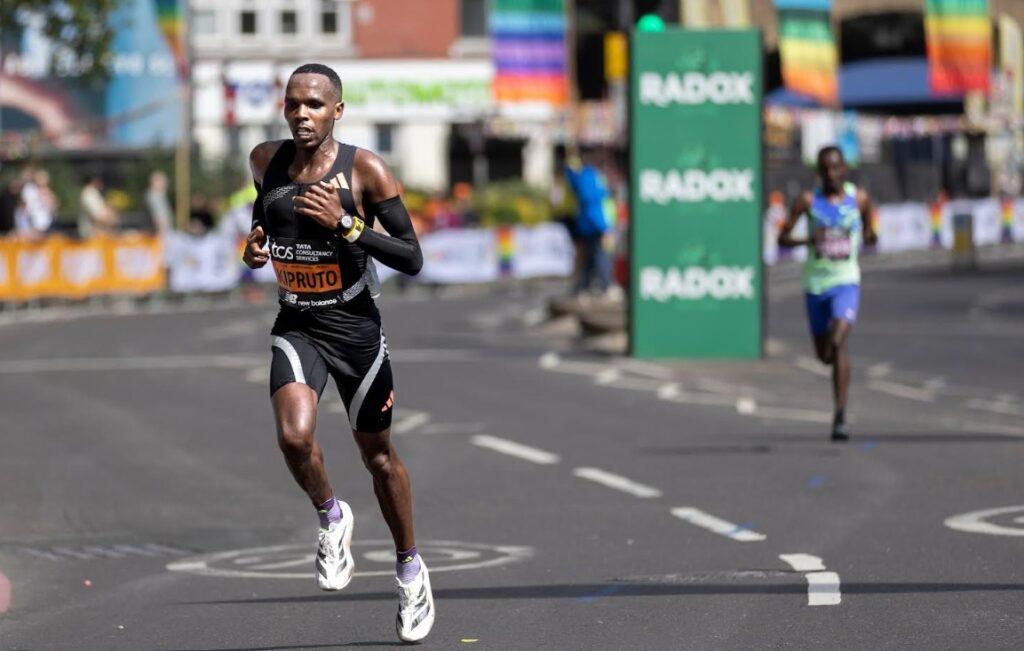
Uganda’s Jacob Kiplimo was third, inside Kiptum’s former world record with a national record 2:00:28, as Kenya’s consistent Amos Kipruto clocked an astonishing personal best 2:01:39 (just 30 seconds lower than Eliud Kipchoge’s record-compliant PB 2:01:09) as the British capital witnessed sporting history.
The top four finishers in Sunday’s greatest marathon ever joined the quartet of astronauts – Commander Reid Wiseman, Pilot Victor Glover, and NASA Mission Specialists Christina Koch and Jeremy Hansen (Canadian Space Agency) – in proving that, indeed, no human is limited.
Sawe, 31, retained the men’s marathon crown in a barrier-breaking contest that saw two athletes dip below the historic sub two-hour mark and three cross the Finish Line inside the previous world record.
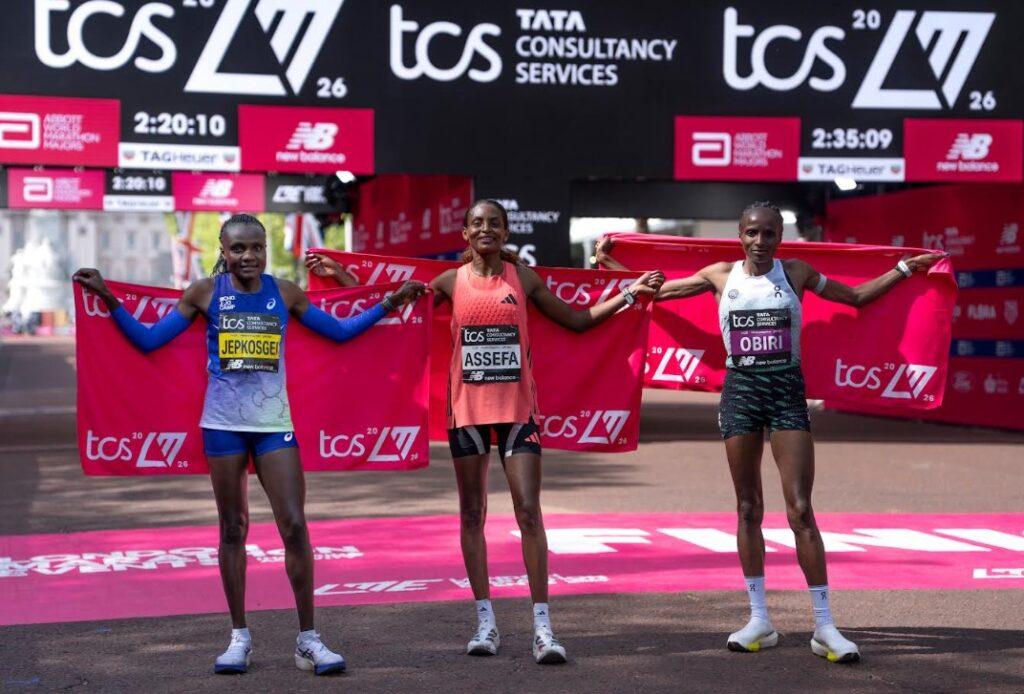
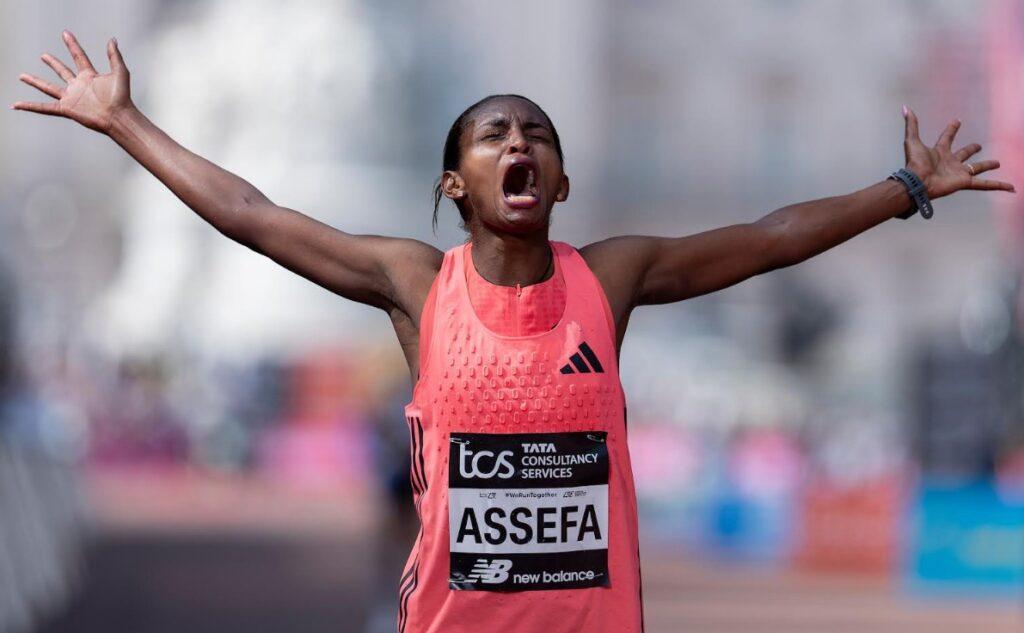
It was a history-making day in the women’s race too, as Ethiopia’s Tigst Assefa improved the women-only marathon world record she set on the same course 12 months ago, retaining her title in 2:15:41, as three athletes crossed the line under 2:16 for the first time in a women’s marathon.
The Kenyan pair of Hellen Obiri (personal best 2:15:33) and Joyciline Jepkosgei (2:15:55), together with Assefa all dipped under 2:16, another important landmark in women’s marathon running.
Assefa said some extra speedwork sessions were the game-changer: “Thank you to God. I screamed when I finished because I knew I was breaking the World Record. I’m so happy because I’ve been more focused on my speed work. I knew I could find the energy and I could win on my speed.”
“I felt much healthier today and have worked really hard on my speed and all my training has paid off. Thank you to God for this fantastic competition, and I wanted to thank my opponents, many of whom are my friends. They’ve done great, and well done!”
“During the competition I felt really good and full of running. I’ve recorded my 800m running experience and I knew that I would have the speed to finish in first place… They (second-placed Hellen Obiri and third placer Joyciline Jepkosgei) are tough competitors. I respect them and I think, between us, we’ve made a great competition today.”
Obiri’s reaction?: “The first half was so great and so fast. I kept pushing throughout. I’ll be out celebrating with my family tonight. I’m super happy getting 2:15. It was a fantastic new experience running with pacemakers.”
It was a show of force from the 2025 champions, with all four successfully defending their crowns – another London Marathon-first.
Marcel Hug dominated the men’s wheelchair race to clinch his eighth title to join Britain’s David Weir as the most successful elite athlete in the event’s 46-year history.
Meanwhile, fellow Swiss Catherine Debrunner triumphed again in the women’s race after a thrilling head-to-head against former champion Tatyana McFadden.
Sawe reflects on record run
Sawe reflected on his earth-shattering run, saying he only knew the clocked had stopped before the two-hour mark after the race had concluded: “It means a lot. I want to inspire young people from my country, to give them hope.”
“I think I realised (sub-two time) when finishing the race because I was so focused on competing with my friend, Yomif [Kejelcha]. Finally, he dropped and in the finishing line I saw I was in one hour 59 and that’s when I realised… It is a day to remember for me and the family.”
Kejecha’s sub-two run was, obviously, the fastest ever by a debutant: “I really didn’t think about it. I thought I’d be more around 2:01-2:04, but my coaches believed in me. I’m so happy and proud of myself. This is my dream. I felt I ran a relaxed and controlled race up until 41km and then my legs were done.”
“My track-training work has been very helpful and it’s been truly amazing to be training in Ethiopia. I’m sure many people at home are very proud of me and many of them believe in my ability to run faster.”
Most inclusive London Marathon ever
Behind the elites came the masses – the club runners, fancy dress-wearers and charity fundraisers who completed the journey from Greenwich to The Mall in their tens of thousands, with a record-breaking 58,250 having crossed the Finish Line by 18:15 on Sunday evening.
In addition, more than 1,900 participants with disabilities made this the most inclusive London Marathon ever, on a day Hugh Brasher, the Event Director, hailed “the greatest weekend in London Marathon history”.
“It’s been incredible, truly historic,” said Brasher. “We’ve got some incredible sports performances, incredible people raising money for charity, and we have the highest number of participants with a disability and the most diversity we’ve ever had.
“We’ve had elite performances that have never been done before, that people said couldn’t be done,” he added. “It’s a day almost indescribable in its joy and in its sense of achievement. I honestly couldn’t be happier.”
The TCS London Marathon is the world’s largest annual one-day fundraising event. Already this year, £38,072,978 has been raised on Enthuse, the official fundraising platform. This is a record figure raised by Marathon Day on the platform, and a 22% increase on the figure on the same platform 12 months ago. The full charity total of the 2026 TCS London Marathon will be announced in the coming months when all the fundraising has been collated.
Among the tens of thousands on the roads were more than 700 fundraising finishers for Charity of the Year, Marie Curie. These included dancer AJ Pritchard, who echoed the feelings of many celebrity runners, saying: “I feel super-exhausted and emotional.” (Additional reporting by TCS London Marathon; all photos by TCS London Marathon)
Elias Makori, the founder and Managing Editor of Pura Vida Sports Africa, is a veteran sports journalist with over 30 years’ experience. Makori is a holder of a Masters in Sports Management degree from Barcelona’s Cruyff Institute and is also the 2012 World Athletics Journalist of the Year, three-time Kenya Sports Journalist of the Year and twice Africa Sports Media Personality of the Year.
Stay in the Know! Subscribe to our Official Newsletter for periodical updates.